

the decree. A spouse can generally withdraw consent before that point. Once the decree has been passed, however, a later change of mind is not the same as a legal challenge based on fraud, coercion, lack of genuine consent or another serious defect.
Section 13B of the Hindu Marriage Act, 1955 provides the principal framework discussed below. The correct remedy depends on the stage of the case, the defect alleged, the evidence and the applicable procedure. This article explains the process, withdrawal before decree, post-decree challenges, settlement disputes and the leading Supreme Court decisions.
Quick answer: A spouse may generally withdraw consent before a mutual-consent divorce decree is passed. After the decree, challenging it is a different legal issue and usually requires a recognised ground such as lack of genuine consent, fraud, coercion or another serious defect.
Mutual Divorce Challenge at a Glance
| Situation | General legal position |
| Mutual-divorce petition filed | Both spouses’ consent remains relevant |
| Consent withdrawn before decree | Divorce generally cannot proceed under Section 13B on the original consent alone |
| Consent withdrawn after first motion | Continuing consent is still required |
| One spouse refuses the second motion | The court must examine whether mutual consent continues |
| Divorce decree already passed | A challenge becomes a separate legal question |
| Mere regret after decree | Not by itself the same as invalid consent |
| Fraud or coercion alleged | May support a challenge, depending on proof and procedure |
| Settlement breached | Does not automatically invalidate the divorce decree |
What Is Mutual Consent Divorce in India?
Mutual consent divorce is a court process in which both spouses jointly seek dissolution under Section 13B of the Hindu Marriage Act, 1955. Section 13B(1) requires the spouses to have lived separately for at least one year, been unable to live together and agreed to end the marriage.
Key requirements
- Living separately for one year or more
- Inability to live together
- Mutual agreement to dissolve the marriage
- Continuing consent through the statutory process
Both spouses present the petition and make the second motion jointly. Signing the petition begins the process; it is not irrevocable consent to a future decree. See the Hindu Marriage Act, 1955.

What Is the Procedure for Mutual Consent Divorce in India?
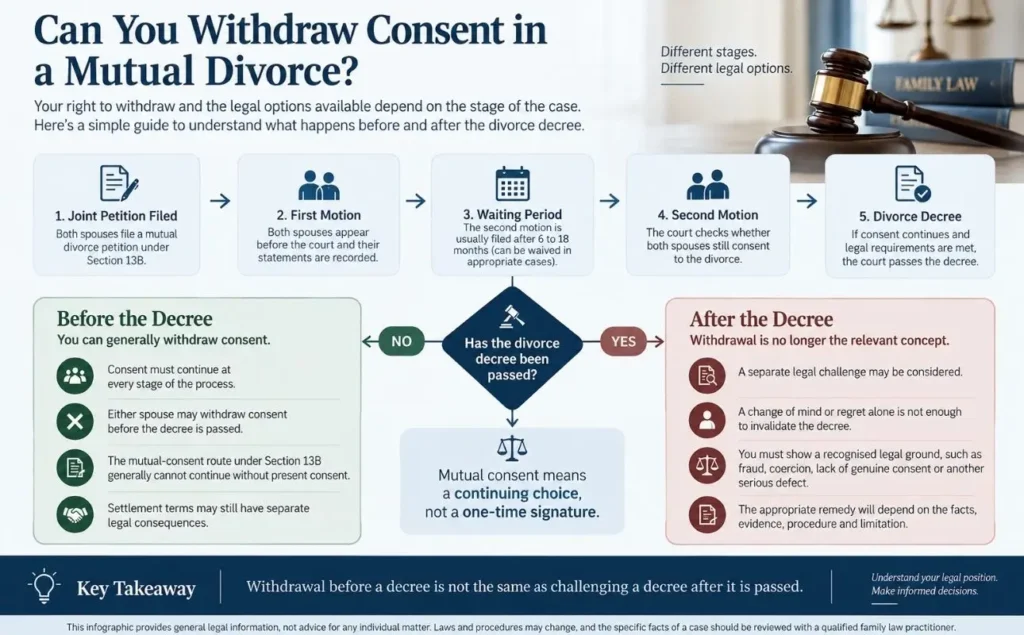
The process involves a joint petition, first motion, statutory waiting period, second motion and final decree.
Step 1 — Filing the Joint Divorce Petition
Both spouses file under Section 13B(1) before a court having jurisdiction. The petition records the separation, inability to live together, agreement to divorce and relevant settlement terms.
Step 2 — First Motion and Appearance Before the Court
Both spouses ordinarily participate. The court examines the petition, interacts with the parties where necessary and records their statements.
Step 3 — Scrutiny and Recording of Statements
The court considers the pleadings, documents, statements and settlement. Under Section 23, it must be satisfied that consent was not obtained through force, fraud or undue influence.
Step 4 — First Motion Order
After recording the first motion, the court passes an appropriate order. The first motion does not itself dissolve the marriage. Both spouses remain married until the final decree.
Step 5 — Cooling-Off Period and Its Waiver
Section 13B(2) places the second motion between six and eighteen months after presentation of the petition. Amardeep Singh v. Harveen Kaur held that the six-month period may be waived in an appropriate case. Shilpa Sailesh v. Varun Sreenivasan discussed Section 13B and the Supreme Court’s distinct Article 142 power.
Step 6 — Appearing for the Second Motion
At the second motion, the court ascertains whether both parties still seek divorce. Continuing consent is a jurisdictional requirement and cannot be presumed from earlier statements.
Step 7 — Decision of the Court and Divorce Decree
If consent continues and the legal requirements are met, the court dissolves the marriage by decree. Withdrawal before that date and a challenge afterward raise different issues.
Can a Spouse Withdraw Consent Before the Divorce Decree?
Yes. A spouse can generally withdraw consent before the mutual-consent divorce decree is passed. The Supreme Court has held that mutual consent must continue until the decree.
In Sureshta Devi v. Om Prakash, the Court explained that consent must subsist when the court is called upon to pass the decree. In Hitesh Bhatnagar v. Deepa Bhatnagar, the Court reaffirmed that a decree under Section 13B cannot be based on presumed consent when one spouse no longer agrees.
Can Consent Be Withdrawn After the First Motion?
Yes. Consent remains necessary after the first motion. An earlier signature or statement does not necessarily establish continuing consent if a spouse withdraws before the decree.
What Happens If One Spouse Changes Their Mind?
A change of mind before decree may stop the mutual-consent route, although settlement consequences can remain. This differs from alleging that consent was legally defective because of fraud, coercion or undue influence.
Can the Court Grant Divorce After Consent Is Withdrawn?
Generally, no—not under the ordinary Section 13B route. A Family Court cannot substitute the original petition for present consent. The Supreme Court’s exceptional Article 142 power is different.
Before the decree
| Event | General position |
| Petition filed | Mutual consent is required |
| First motion completed | Consent remains relevant |
| Consent withdrawn | Section 13B route generally stops |
| Second motion with continuing consent | Court may consider the decree |
Can a Mutual Divorce Decree Be Challenged After It Is Passed?
A completed decree differs from a pending petition. Regret or dissatisfaction does not establish invalidity; a post-decree challenge requires a material legal defect and a maintainable remedy.
Important distinction: Withdrawing consent before a decree and challenging a decree after it has been passed are different legal situations.
Is a Mutual Consent Divorce Decree Appealable?
Section 28 provides the appellate framework for decrees and specified orders. However, a challenge to a consent decree may also involve procedural rules, limitation and the nature of the allegation. Appeal, review, recall and enforcement are not interchangeable, so the appropriate route must be identified from the record and alleged defect.
Is a Change of Mind Enough to Challenge the Decree?
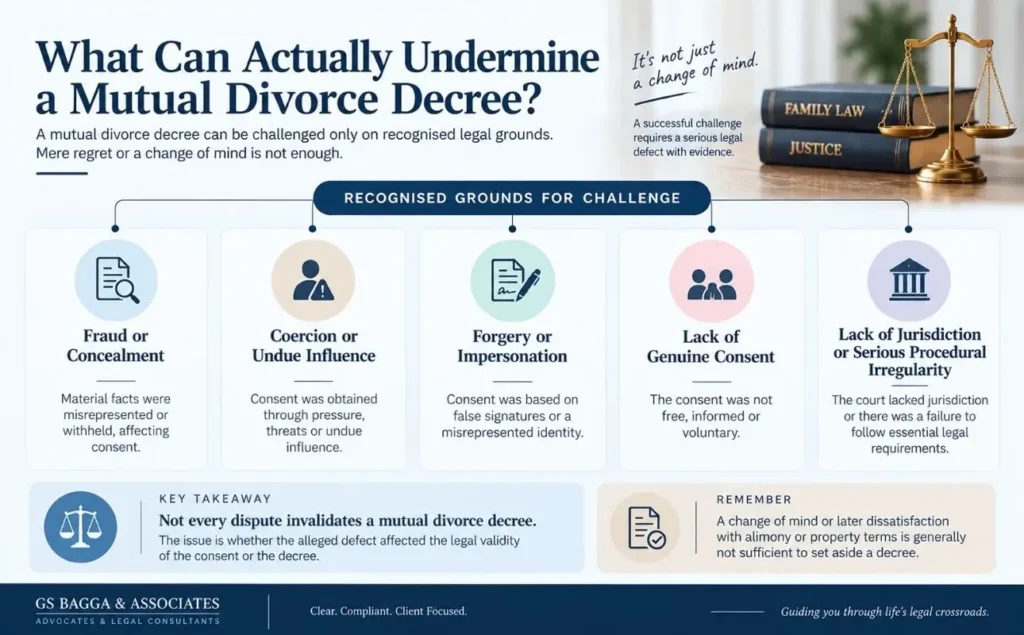
Usually, regret alone is not equivalent to invalid consent. Later dissatisfaction with alimony or property terms is also different from proving fraud, coercion, undue influence, forgery, impersonation, want of jurisdiction or another serious defect that existed when the decree was obtained.
On What Grounds Can a Mutual Divorce Decree Be Challenged?
A post-decree challenge requires more than a change of mind. Relevant issues include genuine consent, deception, pressure, jurisdiction and compliance with essential legal requirements.
Fraud or Concealment of Material Facts
Fraud must be material to consent or the judicial process. The person alleging it should identify the deception, explain its effect and provide reliable evidence.
Coercion or Undue Influence
Under Section 23, the court considers whether consent resulted from force, fraud or undue influence. Threats or unlawful pressure may undermine consent, but supporting evidence and timing matter.
Forgery, Impersonation or Lack of Free Consent
Forgery, impersonation or falsely represented consent differs from regret after a valid appearance. Allegations require support from the court record, identity evidence, signatures, statements and surrounding conduct.
Lack of Jurisdiction or Serious Procedural Irregularity
A material jurisdictional defect, failure to meet an essential statutory condition or denial of participation may support a challenge. Minor errors do not automatically invalidate a decree.
What Legal Remedies Are Available After a Mutual Divorce Decree?
There is no universal remedy. Depending on the defect and procedural history, an appeal, review, application before the original court or another maintainable proceeding may be relevant. Limitation and later events, including remarriage, can matter.
For unpaid alimony, untransferred property or breached custody terms, enforcement may be more appropriate than attacking the divorce. The first step is identifying whether the objective is to set aside the decree, correct an order or enforce the settlement.
Can a Mutual Divorce Settlement Be Challenged?
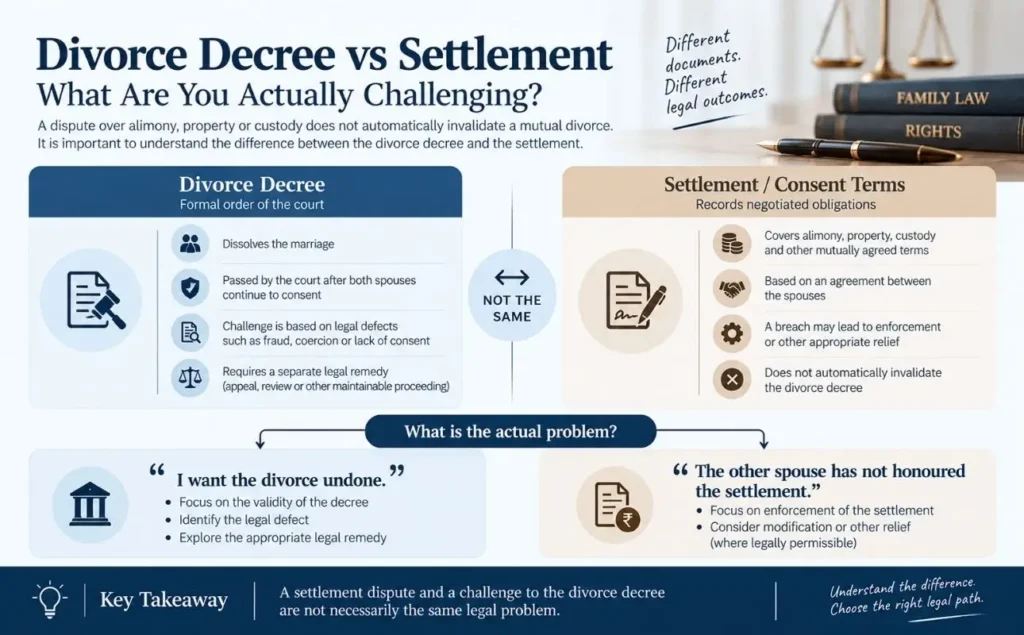
A dispute over a settlement does not automatically invalidate the divorce decree. The settlement agreement, consent terms and decree may overlap, but they are not always identical. The wording of each document determines which obligations were incorporated into the decree and how they may be enforced.
What Is the Difference Between the Settlement and Divorce Decree?
The settlement records negotiated promises about alimony, property, custody, litigation or other matters. The decree is the court’s formal dissolution of the marriage. A dispute over one obligation does not necessarily establish that consent to the divorce was invalid.
What Happens If Alimony, Property or Custody Terms Are Breached?
Non-payment of alimony, failure to transfer property or breach of a custody arrangement may justify enforcement, modification where legally permissible or other relief. It does not automatically cancel the divorce.
| Dispute | Does it automatically invalidate the divorce? |
| Alimony not paid | No |
| Property obligation breached | No |
| Custody term disputed | No |
| Consent allegedly obtained by fraud or coercion | A different legal question requiring evidence |
Important Supreme Court Decisions on Mutual Consent Divorce
| Case | Principle and relevance |
| Sureshta Devi v. Om Prakash (1991) | Mutual consent must continue until the decree; either spouse may withdraw before that stage. |
| Hitesh Bhatnagar v. Deepa Bhatnagar (2011) | The court cannot presume continuing consent after one spouse has withdrawn it. |
| Amardeep Singh v. Harveen Kaur (2017) | The six-month cooling-off period may be waived in an appropriate case when the relevant conditions are met. |
| Shilpa Sailesh v. Varun Sreenivasan (2023) | Explains Section 13B alongside the Supreme Court’s extraordinary Article 142 power; that power is distinct from ordinary Family Court jurisdiction. |
A 2026 Supreme Court decision concerning a mediated settlement and partial performance has also been discussed as taking a strict view of unjustified resiling while using Article 142 to dissolve the marriage. Its exact case name, citation and official text should be verified before publication; it should not be presented as allowing Family Courts to ignore withdrawn consent.
Frequently Asked Questions About Challenging Mutual Divorce
Can One Spouse Refuse to Appear for the Second Motion?
Yes. If one spouse does not participate or states that consent no longer continues, the court must examine whether the statutory basis for mutual-consent divorce still exists. The earlier joint petition does not automatically answer that question.
Can a Mutual Divorce Be Cancelled Because One Spouse Regrets It?
Before the decree, withdrawal may stop the mutual-consent route. After the decree, regret alone ordinarily does not establish invalidity. A recognised legal defect and a maintainable remedy are generally required.
Does Breach of Settlement Invalidate the Divorce Decree?
No, not automatically. A breach may justify enforcement or another appropriate remedy, but it does not by itself prove that the divorce decree was invalidly obtained.
Can Mutual Divorce Be Challenged After Alimony Has Been Paid?
Payment does not conclusively determine validity. It may be relevant to conduct, reliance and settlement performance, but the alleged legal defect, evidence, limitation and available procedure remain decisive.
Conclusion
Whether a mutual-consent divorce can be challenged depends primarily on whether the decree has already been passed and what legal defect is alleged. Before decree, mutual consent must ordinarily continue, and either spouse may generally withdraw it. After decree, mere regret is different from proving fraud, coercion, lack of genuine consent, forgery, jurisdictional error or another serious defect.
A settlement dispute also does not automatically invalidate the divorce. The appropriate remedy may involve challenging the decree, enforcing the settlement or seeking another form of relief. Because procedure and limitation can determine the outcome, anyone considering withdrawal or a post-decree challenge should obtain case-specific advice promptly from a family-law practitioner.
Disclaimer: This article provides general legal information, not advice for any individual matter. Statutory interpretation and procedural practice may change, and the complete court record should be reviewed before action is taken.